


The untapped potential of district heating

In the same way that buses and trains are a more energy-efficient way to transport people around cities than cars, district heating systems can be a more productive way to heat buildings than individual boilers. Indeed, they are a bit like public transport networks for heat. By distributing heating and hot water to homes, businesses and public buildings from a central source, district heating systems can be more efficient and less polluting.
The concept can be traced back as far as the Ancient Romans with their public bath-heated buildings and, today, China, Russia and Europe are responsible for the majority of global district heating production. In some areas of Northern Europe, district heating meets most heating needs. In Copenhagen, Denmark, for example, about 98% of buildings are served by the technology. It is a major source of heat for cities in countries like Finland, Iceland and Sweden, too.
Momentum for district heating in some countries and regions continues to grow, especially across Europe, where it has gained increased political backing since the energy crisis of 2022. At the same time, the decarbonization potential of such systems is coming into sharper focus.
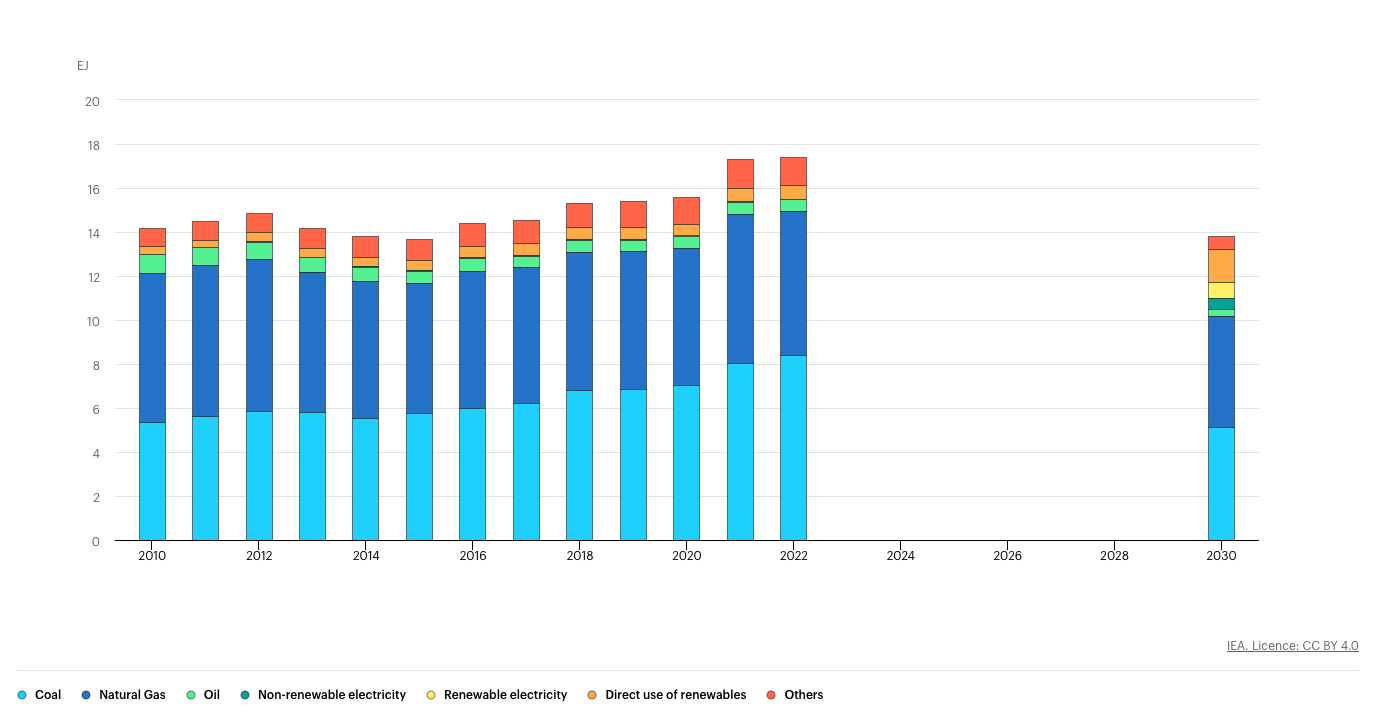
Untapped potential
While district heating can be both cost- and energy-efficient, it contributes close to 4% of global CO2 emissions. This is because 90% of the heat from district networks is currently produced using fossil fuels.
And yet, as the International Energy Agency (IEA) points out, the potential is there for district heating to help — not hinder — decarbonization efforts. In the EU, for example, where space and water heating represents over three-quarters of the final energy consumed by households, just over 26% of that energy is provided by renewables. In Czechia, the UK, Denmark and Finland, government and industry are working to increase that percentage.
It’s still a “largely untapped” area, says the IEA, with much greater efforts needed to switch existing networks to renewable heat sources, such as bioenergy, solar thermal, heat pumps and geothermal. There is also the need to develop new high-efficiency infrastructure, as well as the opportunity to integrate secondary heat sources — such as waste heat from industrial installations and data centers — into district heating systems.
Next-generation district heating
China and Canada are already doing exactly that with, respectively, nuclear power and wastewater plants feeding their district networks. While in Denmark, Facebook’s data center in Odense is channeling 100,000 MWh of waste energy into the local heating network.
Recent technological advancements have further expanded the potential of district heating.
For example, Mitsubishi Heavy Industries (MHI) Group company Turboden has developed large heat pumps that are capable of efficiently transferring low-temperature heat into higher temperatures and are suitable for everything from older district heating networks to the most up-to-date systems. The heat pumps can achieve temperature lifts of more than 100°C to deliver hot water up to 150°C and can create steam at customized pressures.
These systems are also compatible with renewable energy sources, meeting the needs of modern district heating systems.
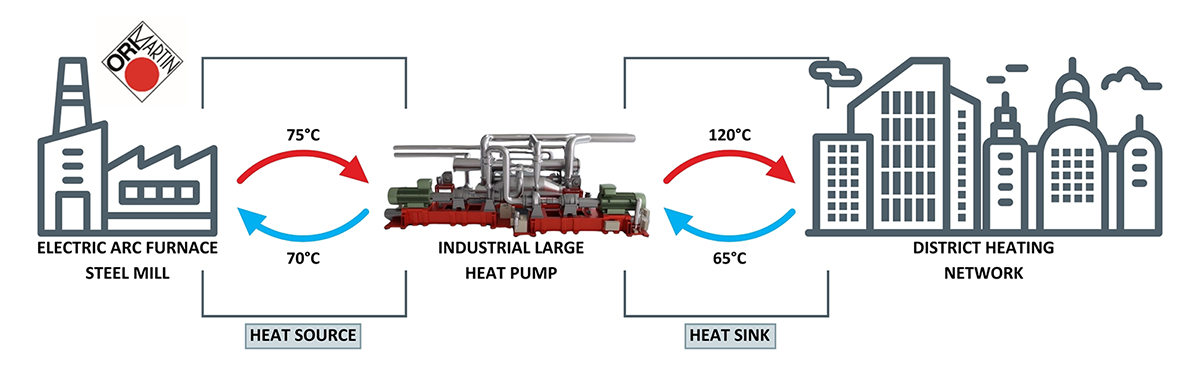
At the Brescia plant of ORI Martin, a leading steelmaker in Italy, Turboden has built a large heat pump that utilizes waste heat from the electric arc furnace. The plant delivers 6 MW of thermal power for the city's district heating network, helping to reduce local emissions, while adapting its operation to the specific process conditions.
The technology is there to shift district heating into the decarbonization limelight. What’s needed now are the policies and investments to scale it up. Europe is currently leading the way with the integration of renewables and industrial waste heat in district heating, but the world must double the amount of renewable energy going into district networks by 2030 if it is to meet its climate goals.

Learn more about Turboden’s large heat pump solutions
Related tags
SHARE


Madeleine North
Madeleine North has almost 30 years' journalism experience as a writer and editor for leading UK publications.
MHI endeavors to ensure all content published on Spectra is accurate and current at the time of publication; however, data and links are subject to change, and MHI accepts no responsibility for information that has since been updated or amended. For more information please refer to our Terms of use.