


Powering Southeast Asia’s data center boom

The state of Johor in Malaysia is a mostly flat, jungle-covered landmass that has long been a major producer of palm oil, rubber and crops including bananas. Today, attention is turning to a new kind of low-hanging fruit for the region — the soaring need for new data centers.
With lower land costs and cheaper energy than neighboring Singapore, the state capital Johor Bahru is emerging as a vital hub for the data centers that power Southeast Asia’s digital economies, cloud computing and AI.
Johor’s transformation into a digital infrastructure corridor is indicative of a wider trend across many Asia-Pacific economies. As demand for AI soars, tech companies are investing in new facilities in the region. At the same time, many of those companies and nations also cite decarbonization of power as key to their collective net zero ambitions.
Balancing an estimated jump in electricity demand with a sustainable energy future is an increasing priority for regional governments.

Data centers in Southeast Asia
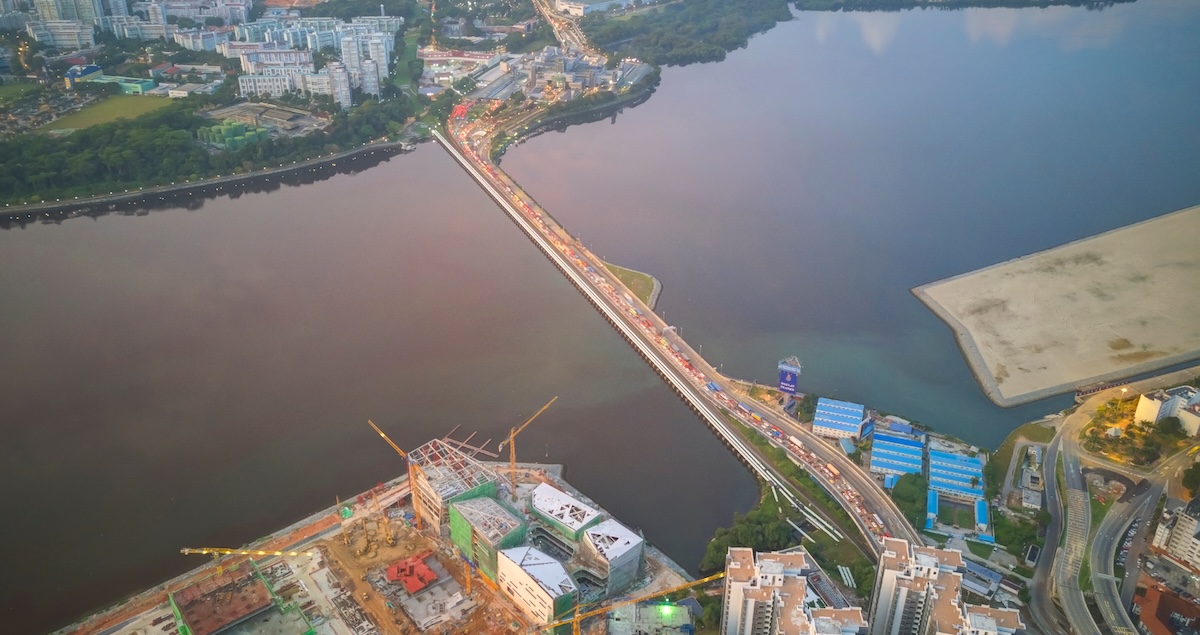
With causeways across the Johor Strait to Singapore, Johor Bahru provides bridges— both literal and figurative — to the city state, especially since the recent creation of the Johor-Singapore Special Economic Zone to increase connectivity between the countries it links.
Singapore is a leading data center hub in Southeast Asia, currently holding about 60% of the region’s total capacity. But its ability to host more large-scale facilities is limited due to its relatively small size and a reliance on imported energy resources.
Just a few kilometers away at its closest point, Johor Bahru is benefiting from this. It has attracted major investment from tech firms — many of them Chinese — including a partnership between US cloud services provider Oracle and TikTok owner ByteDance.
That multibillion-dollar deal is reported as being a driving factor in Johor’s transformation into one of the world’s largest AI hubs. It’s not alone — big technology companies are eyeing expansion across Southeast Asia.
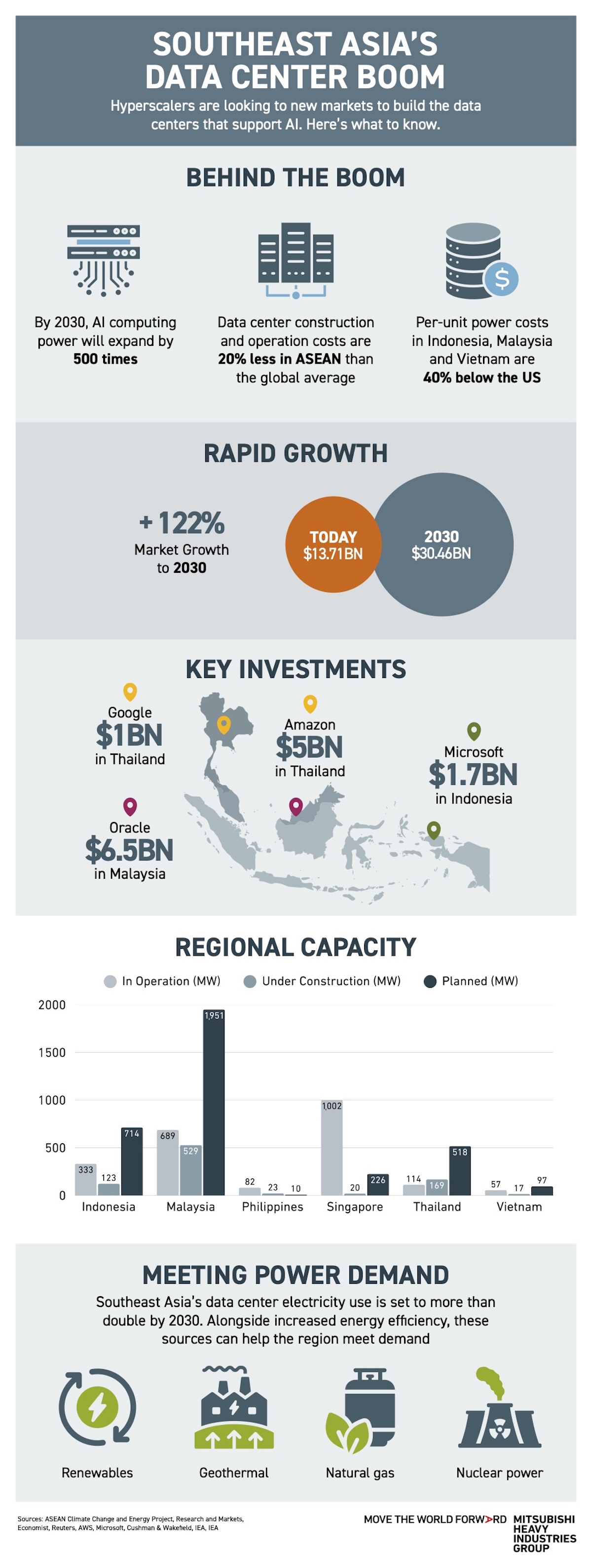
US tech firms, many of which have their Asia headquarters in Singapore, are among those ramping up investment. Away from Malaysia, key deals include investment in Thailand in the form of Google’s $1 billion data center and cloud infrastructure plan, Amazon Web Services’ $5 billion commitment to expand its infrastructure footprint in the same country, and Microsoft’s $1.7 billion cloud and AI spend in Indonesia.
By 2028, it’s predicted that Malaysia and Indonesia will both overtake Singapore in terms of their share of total data center capacity in Southeast Asia.
Behind the boom: Why Southeast Asia?
As Southeast Asia builds its capacity, its data center market growth is set to outpace the global average over the next few years.
There are several factors driving this. Data centers are critical infrastructure that will support a huge growth in digital demand in the region as young, tech-savvy populations embrace e-commerce and fintech services, and governments build digital infrastructure and require more data to be hosted locally.
Construction costs, meanwhile, can be about 20% lower than the global average in countries such as Malaysia and Indonesia. And amid geopolitical uncertainty, many countries in the region are seen as providing stable and favorable environments, which is appealing to businesses looking to diversify where their data centers are hosted.
Southeast Asia’s proximity to large economies, including Australia, China, India and Japan, position it as a good base to serve such global clients. For companies building data centers to support AI, this could make the region attractive for tasks such as training AI models, which is not constrained by latency and therefore can, in theory, be undertaken anywhere.
Powering Southeast Asia’s digital growth
As data center capacity in Southeast Asia increases, questions have been raised about how it should meet the accompanying rise in power demand.
The region’s data center electricity use will more than double by 2030, according to the International Energy Agency (IEA). But the grids supplying these facilities are currently heavily reliant on fossil fuels, risking a rise in emissions.
Solar and wind could meet up to 30% of regional data center electricity demand in 2030, according to a report from energy think tank Ember. But what else will it take? Because cloud computing and AI need reliable around-the-clock power, many experts say liquefied natural gas (LNG) can help nations meet near-term demand. Projects such as the ASEAN Power Grid, which is designed to create energy security across the region through cross-border electricity trading and resource sharing, will contribute to providing the resilient infrastructure data centers need.
The vital role of energy efficiency
Increasing the energy efficiency of facilities will play a big part, too, and here cooling is a crucial factor — especially as Southeast Asia’s tropical climate puts significant demands on these systems.
Mitsubishi Heavy Industries (MHI) Group is one company with leading technology in this area. Its centrifugal chillers, which enable energy saving in air conditioning systems, are used in many countries in Asia Pacific, including in Malaysia and in a district cooling system in Marina Bay, Singapore.
The company is also working on incorporating new direct-to-chip liquid cooling systems into its data center equipment. With the GPUs/CPUs that process AI data running 5-10 times hotter than traditional CPUs, this technology is expected to grow in importance as AI continues to boom.
From Singapore to Johor and beyond, Southeast Asia is emerging as a data center powerhouse. As investments increase, ensuring new facilities can operate sustainably will come into sharper focus.

Related tags
SHARE


David Elliott
David Elliott has two decades’ experience working as a journalist, communications professional and content creator, including for some of the world’s biggest technology brands.
MHI endeavors to ensure all content published on Spectra is accurate and current at the time of publication; however, data and links are subject to change, and MHI accepts no responsibility for information that has since been updated or amended. For more information please refer to our Terms of use.