


Collaborative and digital: The future of Japanese shipbuilding

Japan has a rich shipbuilding history. An island nation that relies on maritime trade, it built an impressive merchant fleet and created an environment in which shipbuilding could thrive.
From the government prioritizing the industry in the 1860s to helping to birth modern shipbuilding methods in the 1950s, the country has long pursued innovation and manufacturing excellence in this area.
Shipbuilding speed and efficiency grew significantly as new mass production techniques were refined and processes continuously improved. But in the late 20th century, state-supported competition from nations including China and South Korea grew and Japan’s share of the global industry declined.
Now the country is making a strategic move to regain shipbuilding momentum — with collaboration and digital innovation at the heart of the push.
Why is shipbuilding important to Japan?
Because it enabled the mass export of manufactured goods, shipbuilding had a pivotal role in Japan becoming one of the world’s largest economies.

This led to the country dominating the industry. But in the 1980s, its share of the global shipbuilding market, then around 50%, started to fall as it was overtaken by South Korea and then China. Today, Japan remains the world’s third biggest shipbuilding nation, albeit with around 10% market share — behind South Korea and some way adrift of China’s more than 50%.
The sector remains vital to Japan’s maritime logistics and economy. To keep its place as a key player in the global shipbuilding industry, the country has proposed a $7 billion national shipbuilding fund and is planning to double capacity by 2035.
Boosting competitiveness and efficiency through cooperation and consolidation is seen as key to these efforts. Alongside, it is looking to compete by focusing on the strengths of the nation’s shipyards.
Cross-industry collaboration on next-gen ships
As technological change and the drive for sustainability in shipping accelerates, Japan’s shipbuilders are drawing on their history of quality and innovation to deliver advanced, sustainable and efficient maritime solutions.
Cross-industry collaboration is a key aspect of strategies for delivering these high-performance next-generation vessels.
One example is the recent memorandum of understanding between seven Japanese companies — both shipping firms and shipbuilders — to establish a standard design framework for liquefied-CO₂ (LCO₂) carriers and alternative-fuel ships.
LCO₂ carriers will be a vital link in the CO₂ capture, utilization and storage value chain, enabling large amounts of captured carbon to be transported long distances for storage at low costs. Alternative fuels, such as liquefied natural gas (LNG), methanol and ammonia, will not only need to be transported by ships but will increasingly power them.
Under the agreement, the firms — Mitsubishi Shipbuilding, a part of Mitsubishi Heavy Industries (MHI) Group, Imabari Shipbuilding, K LINE, MOL, NYK Line, JMU, and NSY — will create initial designs for such ships using a shipbuilding platform called MILES (Marine-design Initiative for Leading Edge Solution), which was established in 2013 as a joint venture between MHI and Imabari.
The other five companies have now invested in the platform, and collectively they will work to create designs that other shipyards across Japan will be able to use to develop their own vessels.
Standardizing designs and selling them to other shipbuilders in the country is seen as vital to increasing production efficiency and propelling the industry forward.
LCO₂ carriers transport liquefied carbon dioxide over long distances
Digital design and shipbuilding’s future
Another increasingly important aspect of advanced shipbuilding is employing digital models to streamline design and construction and improve efficiency, quality and safety.
Developing these cutting-edge technologies has been identified by the Japanese government as essential for maintaining the country’s longer-term competitiveness.
In response, a group of 10 organizations from Japan’s maritime industry has joined forces to use digital tools to transform ship design and construction.
The research project includes companies including Mitsubishi Shipbuilding, as well as Osaka and Kyoto universities and the Japan Agency for Marine-Earth Science and Technology. It will create an ‘Integrated Simulation Platform’ that will optimize shipbuilding by modeling the entire life cycle of a ship’s design, construction and operation — including the supply chain — at the initial stages of development.
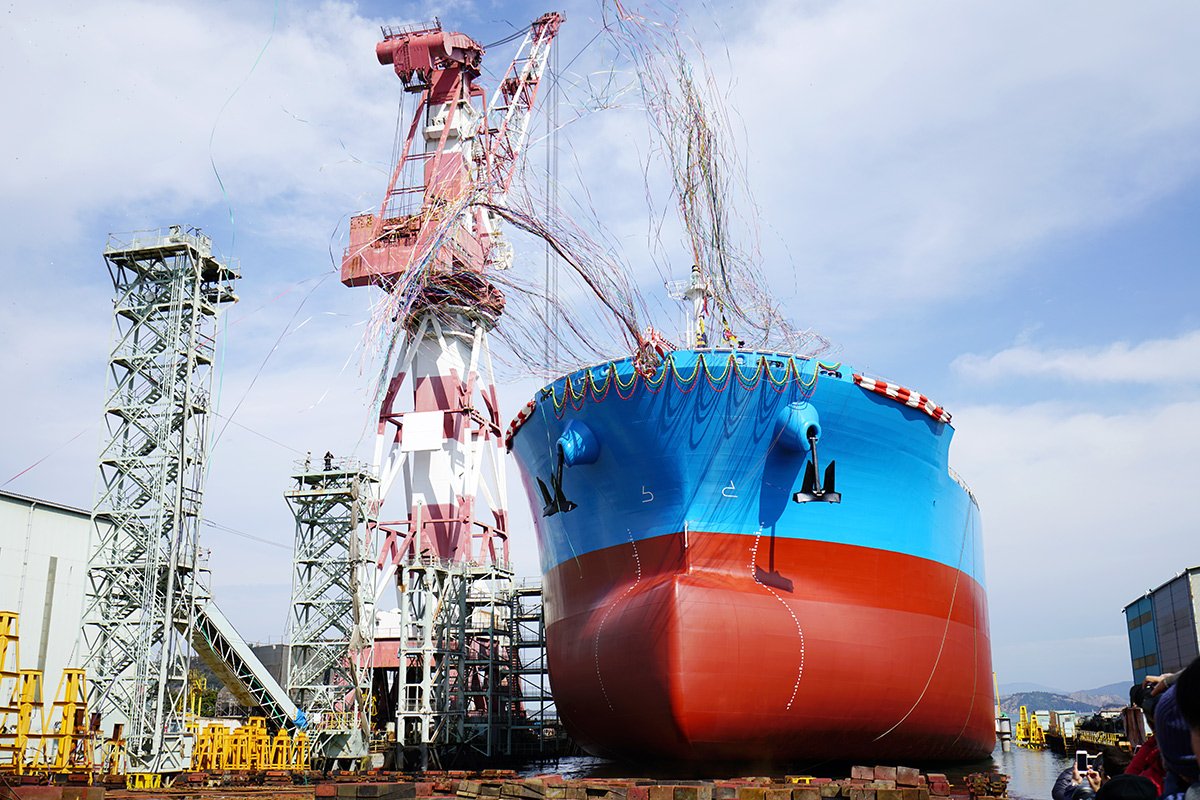
Becoming the world’s No. 1 sustainable shipbuilder
Japan has an ambition to become the market leader in next-generation vessels, including alternative-fuel ships.
By innovating and collaborating to make these advanced ships, Japanese shipbuilders are drawing on their history to navigate competition and changing demands, pioneering the future of the maritime sector.

Discover more about LCO₂ carriers’ role in the energy transition
Related tags
SHARE


David Elliott
David Elliott has two decades’ experience working as a journalist, communications professional and content creator, including for some of the world’s biggest technology brands.
MHI endeavors to ensure all content published on Spectra is accurate and current at the time of publication; however, data and links are subject to change, and MHI accepts no responsibility for information that has since been updated or amended. For more information please refer to our Terms of use.