


Autonomous trucking shifts into gear in Japan

Knight Rider, Transformers, Batman and Blade Runner — these movies have all shaped our ideas of a far-flung future when vehicles will drive themselves. Now, that future isn’t so far-flung anymore.
You’ll still need to wait for a self-driving car to park (itself) outside your home — while costs, infrastructure and regulations continue to evolve — but you can already catch a robo-taxi in major cities in the US and across China.
However, the greatest potential lies in automated trucks, which are expected to reach a market value of $600 billion by 2035, far above that of taxis and passenger cars.
Mitsubishi Heavy Industries’ Machinery Systems (MHI-MS) has been working with the Japanese government to address these and make autonomous trucks safe and efficient to operate on Japan’s expressways.
It is part of the government’s "Digital Lifeline Development Plan", which aims to implement a countrywide digital supply infrastructure.
How can autonomous trucks make logistics more efficient?
There are three key benefits of autonomous trucking:
-
Addressing driver shortages and costs: Trucks carry around 90% of Japan’s cargo. Like many countries, demand for delivery services is soaring in Japan. Yet, the country faces acute shortages of truck and delivery drivers, as well as rising fuel and labor costs.
-
Safety improvements: Last year, the government introduced a law limiting overtime to protect drivers and reduce accidents. With human error contributing to nearly two-thirds of road fatalities, autonomous vehicles can not only alleviate pressure on drivers, but have the potential to save lives.
-
Increased efficiency: Unlike human drivers, automated trucks can operate 24/7 without needing to rest or sleep. In addition, more consistent driving behavior and more efficient routing will speed deliveries, reduce costs and fuel usage. This can lead to fewer emissions, especially when trucking is electrified or uses sustainable fuels.
Creating an infrastructure for autonomous trucks
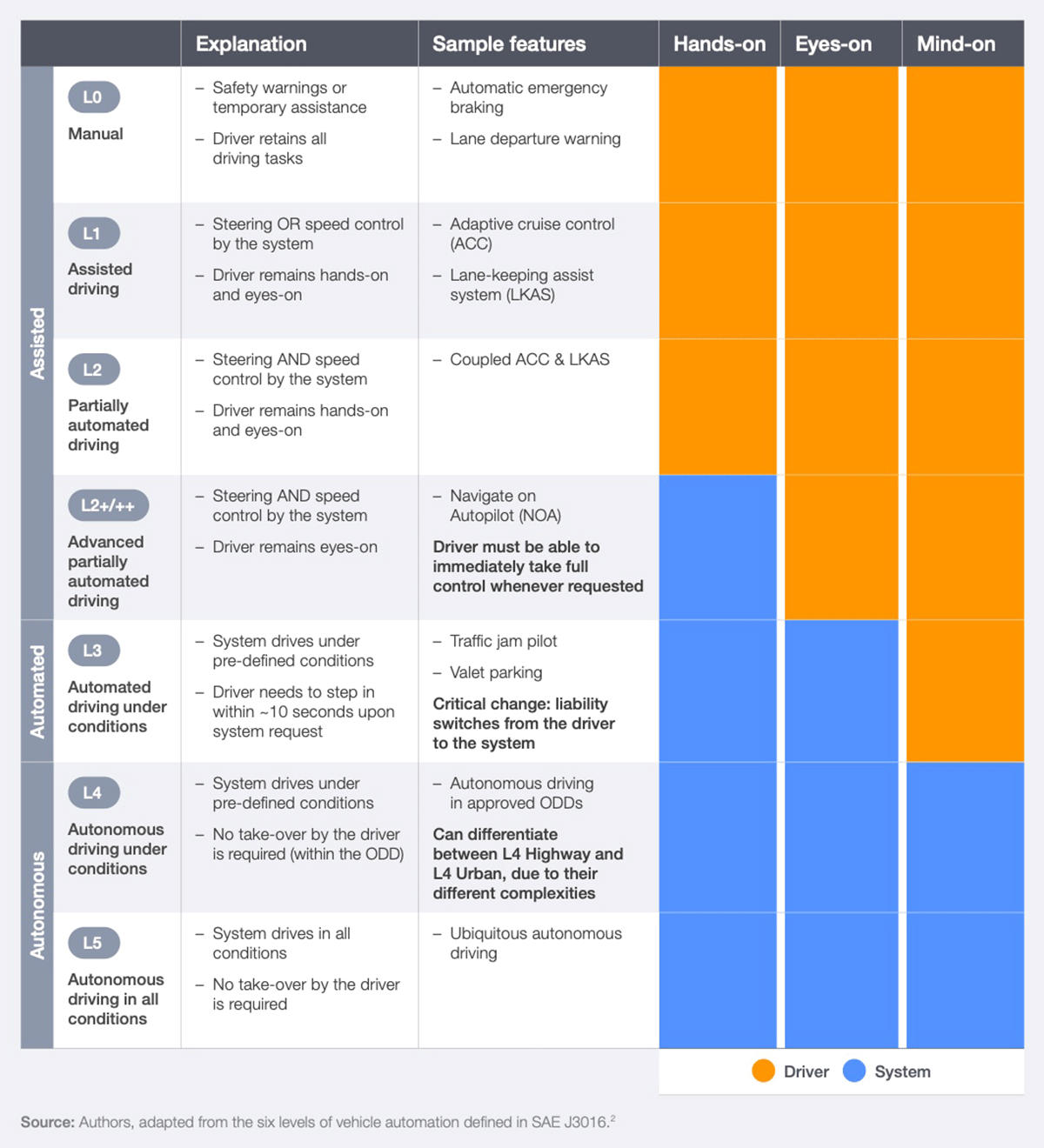
While the concept of a “self-driving vehicle” seems uncomplicated, there are levels of driving autonomy, each requiring less human intervention. The levels start from L0, which is manual with assistance, such as automatic emergency braking. Currently, many cars are L1 or L2, which means they offer driver assistance or are partially automated. The final stage is L5, when a vehicle drives completely autonomously in all conditions.
Yet, reaching the highest levels of driving autonomy is not straightforward, explains Tadayoshi Mannami, General Manager of the Mobility Business Development Department at MHI-MS.
“For truly autonomous driving, vehicles not only have to operate fully by themselves, but they need to talk to each other. This requires transitioning all traffic participants into autonomous vehicles and an underlying control infrastructure to ensure a smooth flow of traffic and prevent accidents.”
Putting this in place for the mass market will take considerable time, investment and effort. For that reason, Mannami believes reaching L5 for passenger vehicles is still quite some time off.
However, for trucks, L4 infrastructure is already being trialed on the Shin-Tomei Expressway, which extends from Japan’s capital Tokyo to Nagoya, in the center of the country.
Testing a complex mix of sensors and information systems
MHI-MS has been involved in the trials since 2022. Its systems provide autonomous vehicles with:
-
Data on obstacles on the road ahead that are too far away for the vehicle’s onboard sensors to detect, avoiding accidents;
-
Information on the best travel speed given road and driving conditions;
-
Data to enable platooning, where vehicles heading in the same direction follow each other closely to reduce air resistance and save energy.
More recently, the company has introduced a Merging Support Information System for self-driving trucks, which is currently also being tested on a stretch of the Shin-Tomei expressway.
The system optimizes the phase when a truck joins the expressway. This is especially tricky in Japan, where expressways are known for challenging merging conditions including on-ramps that are sometimes uphill and merging sections than can be quite short. While the truck is equipped with its own sensors, these can only detect obstacles around the vehicle. They cannot assess the road or traffic conditions on the expressway itself, especially where there is no clear line of sight from the slip road onto the expressway.
“Trucks take time to accelerate or slow down due to their size and weight,” says Mannami. “They need information much earlier than a passenger car would to react in time.”
Real-time radar information makes autonomous truck journeys safer
If merging decisions were left to the onboard sensors as the truck travels down the slip road, the vehicle could be forced to brake or accelerate abruptly once it gets to the merging point. This is risky for other vehicles on the expressway and can also damage cargo.
MHI’s system uses laser sensors (3D-LiDAR) monitoring a 700-meter length prior to junctions to assess vehicle classification, position and speed in the area before the slip road. It digitizes and analyzes this data, then sends it to the truck, helping it choose the best merge point and adjust its speed.
The system is an adaptation of intelligent transport system (ITS) engineering and technologies from MHI, which has a long track record in toll collection, road pricing and traffic management around the globe.
Japan’s autonomous trucks will roll within the decade
Mannami is confident that self-driving trucks will be a fixture on Japanese expressways within the next five years. Once proven, the next step will be to adapt these systems for passenger vehicles.
“Because there are no pedestrians or bikes, expressways and trucks are ideal for trialing and optimizing infrastructure for autonomous driving.”
The infrastructure for autonomous driving that will be implemented on expressways can also be used for passenger vehicle safety assistance, Mannami adds. For vehicle manufacturers, this helps create safer vehicles while keeping costs down.
It is hoped that the shared use of this infrastructure for truck automation and passenger car safety will continue to progress — leading to convenient and comfortable road environments for all users.
Discover more about MHI’s work with Intelligent Transport Systems
Related tags
SHARE


Andrea Willige
Andrea Willige has spent many years creating content for the international business and technology press, working on behalf of some of the world’s largest technology companies.

MHI endeavors to ensure all content published on Spectra is accurate and current at the time of publication; however, data and links are subject to change, and MHI accepts no responsibility for information that has since been updated or amended. For more information please refer to our Terms of use.