


Why Europe is looking to geothermal for baseload energy

Meeting Europe’s rising energy needs while reducing emissions requires innovative methods, like tapping into Earth’s subterranean heat for geothermal energy. Previously, this was only feasible in volcanic regions with accessible underground reservoirs of trapped hot water or steam. Now, enhanced geothermal systems (EGS) allow much broader access, which the EU aims to harness as a reliable, continuous low-carbon power source. But how can geothermal add to Europe’s energy security in practice?
What is geothermal energy, and how can we harness it?
A geothermal plant consists of wells drilled deep into the Earth’s mantle, using water or steam to bring underground heat to the surface. Some of this can be used directly for district heating and cooling, while the rest is converted into electricity.
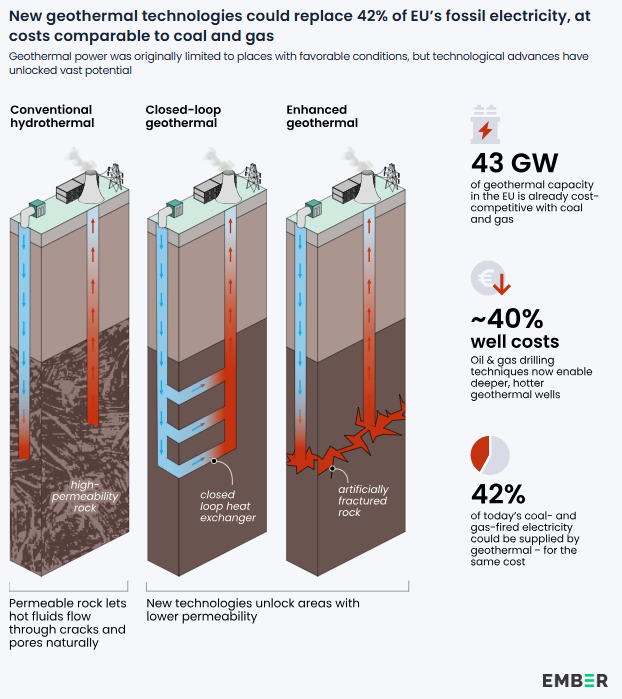
Until recently, access was limited to areas with active tectonics such as Iceland, Kenya’s Rift Valley and Asia’s “Ring of Fire” zone, where these reservoirs are closer to the surface and easy to access. That’s why a vast amount of geothermal resource remains untapped — yet could provide substantial amounts of low-carbon, renewable electricity. However, technologies such as enhanced geothermal and closed loop systems are now changing these economics, unlocking geothermal reservoirs that were previously impossible or uneconomic to exploit.
What is the potential of geothermal in Europe?
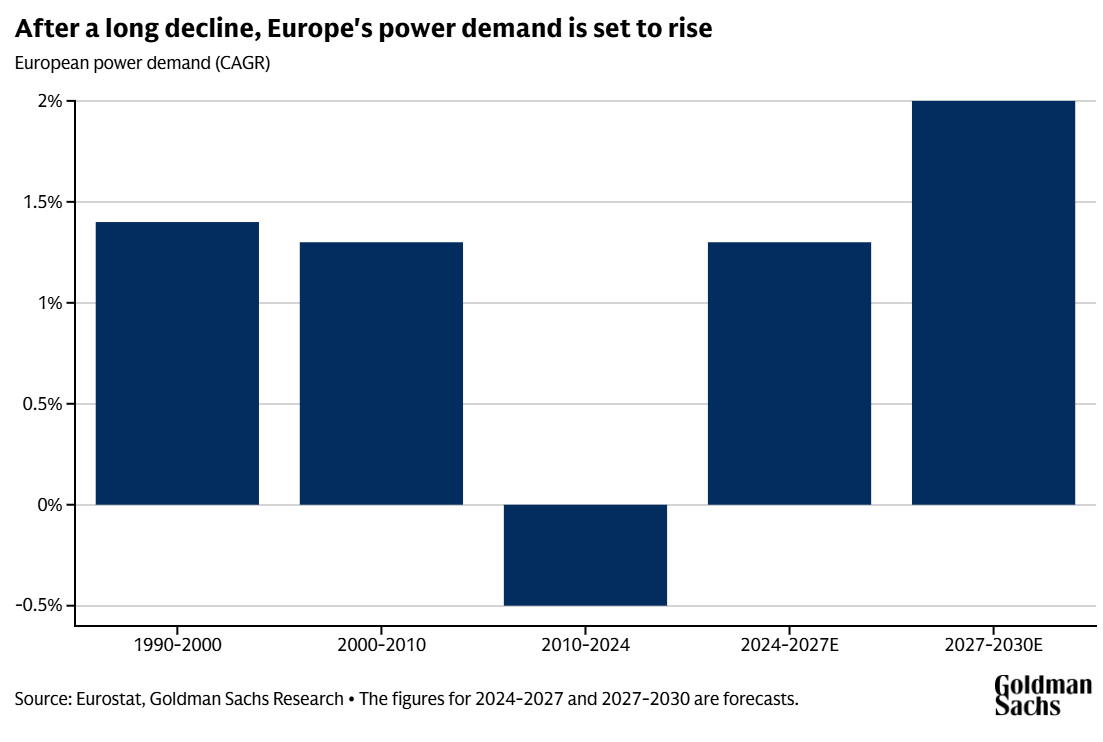
Already established in the US, where these new technologies are on a rapid upward trajectory, they are also now bound for Europe. With electrification progressing and the growth of power-hungry data centers, Goldman Sachs forecasts an increase in Europe’s power needs after 15 years of decline.
Analysts at think tank Ember Energy report that 43 GW of enhanced geothermal capacity in the EU could be developed at costs below €100/MWh, the average cost of gas and electricity. That is equivalent to 42% of the bloc's fossil-fueled power generation in 2025.
Italy, Germany, France, the Iberian Peninsula and southeastern Europe are among the areas with significant potential for providing baseload supply — the minimum, continuous amount of power required on a grid.
As a whole, the earth produces enough geothermal energy to meet global electricity demand more than 100 times over, according to the Center for Climate and Energy Solutions.
Where are Europe’s hubs for geothermal?
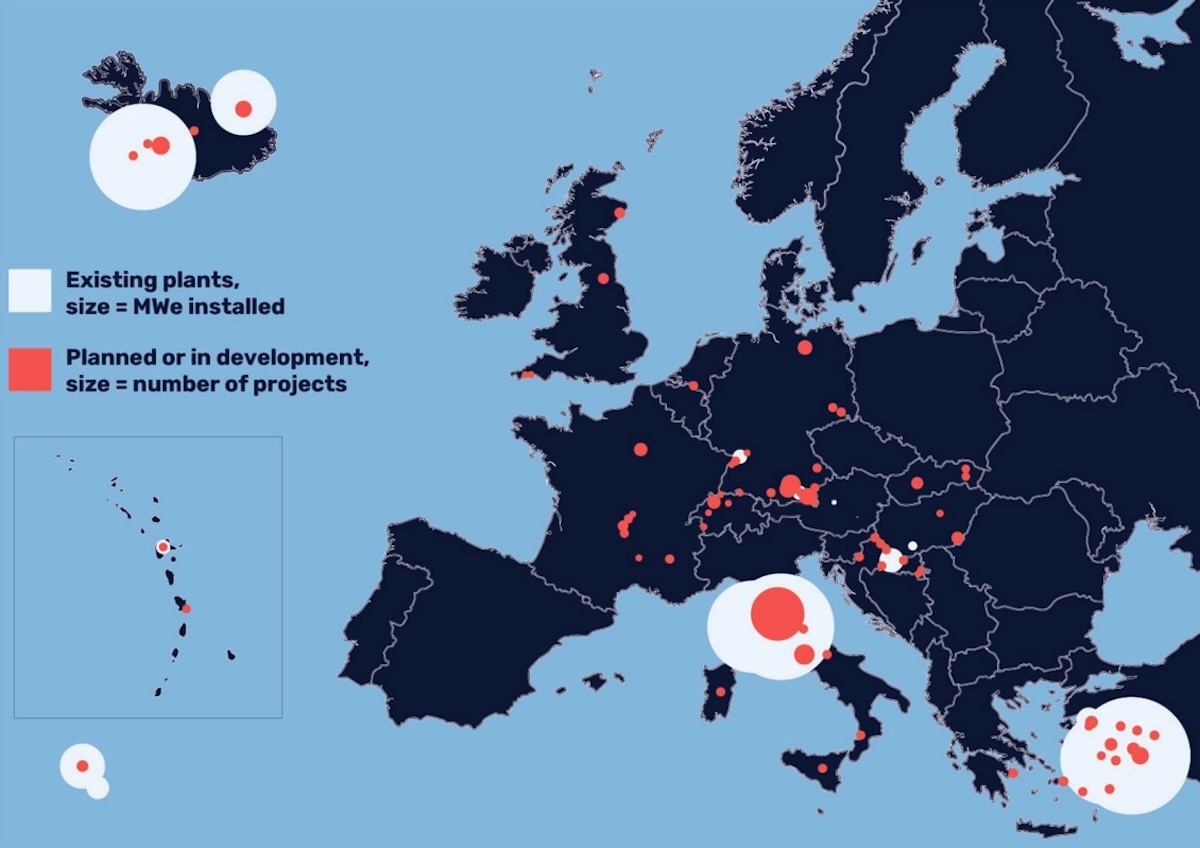
Not only does Europe have great potential for geothermal energy, there is already an established base of geothermal projects throughout the continent.
Iceland is in the lead thanks to its favorable tectonic conditions with 839 MW of geothermal capacity in operation. Italy has 834 MW, followed by Russia (74 MW), Germany (44.5 MW) and Croatia (36 MW). The latter also has the largest prospective capacity (138 MW), a sum of plants under construction, in pre-construction or announced, followed by Russia with 83 MW and Hungary with 50 MW waiting in the wings. Bridging Europe and Asia is the geothermal powerhouse of Turkey, with 1,892 MW in operation and 368 MW of prospective capacity.
Turboden, a Mitsubishi Heavy Industries (MHI) Group company, which supplies its Organic Rankine Cycle (ORC) technology to convert heat into energy, has 24 geothermal projects deployed across the world, of which 14 are in Europe.
This includes the Eavor-Loop in Bavaria, Germany, the first commercial application of closed-loop geothermal technology and a geothermal plant that will both extract lithium and deliver electricity in the Upper Rhine Valley.
However, the installed base of geothermal is low compared to the potential Europe offers. Exploiting it as a renewable resource will require substantial policy support to help overcome development challenges including long project timelines and higher risk in the early phases of exploration.
How are policymakers supporting the expansion of geothermal energy?
This policy support has been building across the EU member states, and at EU level, with the European Commission’s Accelerate EU strategy putting the spotlight on geothermal as a replacement for natural gas in district heating and cooling, and in electricity generation.
The EU’s forthcoming Geothermal Action Plan (EGAP), expected to be released around summer 2026, will make geothermal a strategic policy priority rather than a niche technology. In addition to an EU-level open-access geological database for resource mapping, it is likely to focus on the schemes for derisking and insurance of geothermal projects to simplify access to finance. The European Council has also called for the inclusion of faster permitting to speed the deployment of geothermal power plants.
Several EU member states have already created national geothermal roadmaps, including Ireland, Poland, Croatia, France and Germany, to boost geothermal development through improved permitting and licensing, and simplified access to finance. Finance has been particularly challenging due to the costs and risks associated with early-stage exploration and drilling of new geothermal wells, with failure rates as high as 30%.
What’s next for geothermal energy in Europe?
The foundations are being put in place to convert Europe’s high potential for geothermal energy into a reality, adding to the continent’s energy mix.
Public support for new geothermal projects is also changing, according to a recent academic study. There are some environmental concerns around technologies such as EGS, which can induce seismic activity, underscoring the need for projects to properly monitor and control these risks. However, local benefits such as lower energy costs, job creation and investment in local communities are helping to significantly boost acceptance of geothermal.
If the EU’s plans develop as hoped, we will see our planet’s heat make a much more significant contribution to Europe’s energy security and sovereignty.

Discover more about ORC systems and geothermal energy
Related tags
SHARE


Andrea Willige
Andrea Willige has spent many years creating content for the international business and technology press, working on behalf of some of the world’s largest technology companies.
MHI endeavors to ensure all content published on Spectra is accurate and current at the time of publication; however, data and links are subject to change, and MHI accepts no responsibility for information that has since been updated or amended. For more information please refer to our Terms of use.