


AI and energy: Behind the headlines at Davos 2026

This year’s World Economic Forum meeting in Davos will likely be remembered for its headline-making, with high-profile moments including US President Donald Trump’s news-making special address and appearances from big tech names including Tesla’s Elon Musk and Nvidia’s Jensen Huang.
Away from the headlines, Davos 2026’s theme ‘A Spirit of Dialogue’ played out over a range of interconnecting dimensions, from unlocking growth to deploying new solutions responsibly at scale. Geopolitics, artificial intelligence (AI) and energy cut across the discussions.
Yet despite much talk of the uncertainty caused by tariffs, international tensions and a loss of trust, there was also a strong focus on partnership and optimism around innovation and the future of the energy transition.
Meaningful change starts with collaboration
Change and growth were recurring themes throughout sessions at the Swiss mountain resort. Energy security was framed as national security by International Energy Agency Executive Director Fatih Birol. AI’s rapid growth was presented as both an economic opportunity and a potential risk. And sustainability should not just be about the climate, but growth and prosperity too, delegates heard.
“The world is changing very rapidly,” Eisaku Ito, Mitsubishi Heavy Industries (MHI) President & CEO, said, attending the annual meeting. “But change is an opportunity for everybody, not only a risk.”
Ito said that in speaking to leaders in both government and the private sector, he sensed many opportunities for companies and countries to collaborate. This spirit of cross-sector partnership was highlighted time and again as a path to meaningful progress.
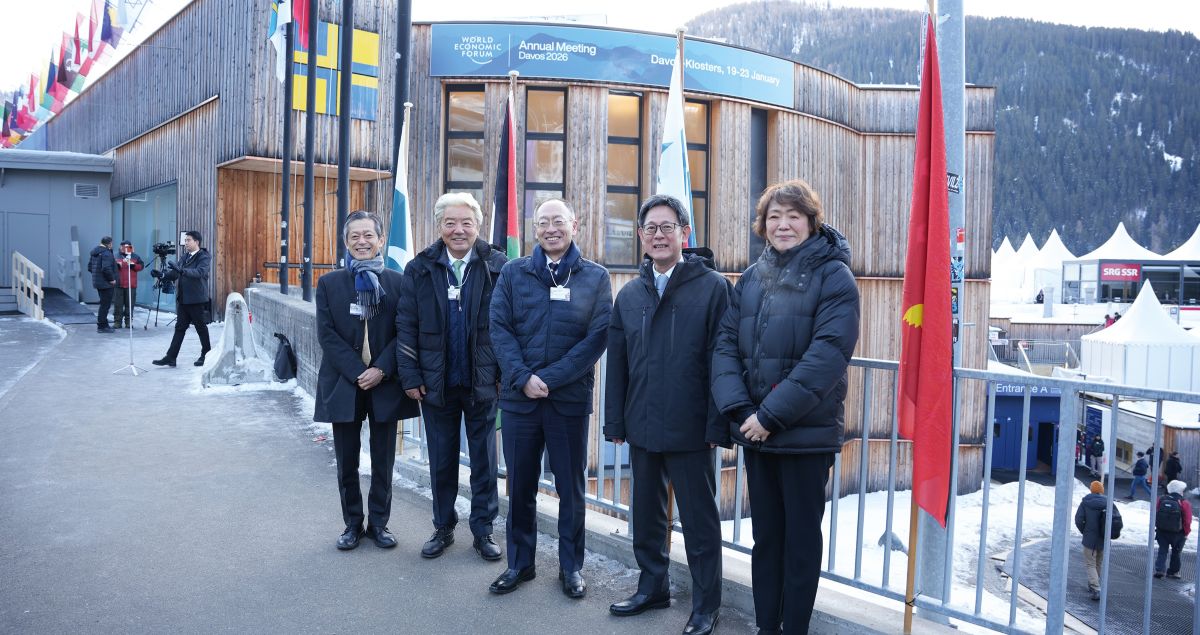
Mitsubishi Heavy Industries President & CEO Eisaku Ito at Davos
A realistic look at nuclear power
This was a sentiment underscored by discussions in a panel session called Clear-Eyed about Nuclear Renaissance, at which MHI’s Ito spoke.
Amid concerns around energy security and the challenge of meeting AI’s growing appetite for power with reliable, affordable low-emissions energy, nuclear is regaining momentum in countries across the globe. At Davos, nuclear was championed in President Trump’s speech and featured in plans outlined by the Czech Republic, India and the UK.
The current moment was described in the session as the most optimistic in nuclear in several decades. Panelists talked of how safety was a prerequisite for progress in this area, and how building standardized reactor designs that can be replicated for other plants would be key to cutting lead times and capitalizing on the momentum.
MHI has many decades of experience in nuclear, and Ito spoke about the company’s collaborative approach, which often involves discussions with utilities, regulators and hundreds of supply-chain companies.
Ito also told the panel that companies such as MHI, with deep experience in industrial processes and technologies, can drive progress by taking innovations from one area, such as gas turbines, and applying them to another — such as nuclear.
Avoiding “rework” wherever possible is vital, he said.
New technology needs human experience
Combining human experience with new technologies to drive progress was also widely discussed. A World Economic Forum report launched at Davos describes how trusted, advanced AI can transform businesses when data, processes and human ingenuity are aligned.
While attending Davos, Takehiko Kikuchi, Chief Regional Officer for Asia Pacific and India at MHI, talked about how AI is being used at the company to collect data from highly skilled industrial practices such as welding. By doing this, the company can combine human skill sets with machines’ consistency and automate dangerous tasks.
Alongside, advanced AI systems are being used to help predict or detect component failure in critical infrastructure such as gas turbines, he added.
AI and energy dominate discussions
Whether it was industrial processes or space-based solar power, Davos discussions repeatedly tracked back to AI and energy.
Satya Nadella, CEO of Microsoft — one of the hyperscalers pumping billions of dollars into new data centers to support AI — highlighted the vital role grid infrastructure will play in ensuring the benefits of AI reach everyone. BlackRock Chairman Larry Fink, meanwhile, noted that AI growth will require dispatchable sources of power — such as natural gas — alongside intermittent renewable sources.
Whatever the generation source, the consensus among many was that the world will need more energy to fuel not just AI but industrialization and economic growth.
But what might that mean for the energy transition?
Partnership means progress
Narratives around this area are shifting. Fatih Birol’s comments that energy security should be elevated to the level of national security are the latest high-profile recognition that the energy transition and energy trilemma — balancing energy security, affordability and sustainability — go hand in hand.
Reports coming out of Davos suggested that, away from the main stage, there were many examples of partnership and collaboration, including countries and companies aligning on clean infrastructure.
As another member of MHI’s delegation, Hiroshi Matsuda, Chief Regional Officer, Europe, Middle East & Africa, affirmed: “Long-term growth can be achieved by a vibrant exchange of ideas, products and services between partners who trust each other.”

Discover more about MHI’s nuclear power generation solutions
Related tags
SHARE


David Elliott
David Elliott has two decades’ experience working as a journalist, communications professional and content creator, including for some of the world’s biggest technology brands.
MHI endeavors to ensure all content published on Spectra is accurate and current at the time of publication; however, data and links are subject to change, and MHI accepts no responsibility for information that has since been updated or amended. For more information please refer to our Terms of use.