


How big data is being used to reduce maritime emissions

Finding ways to reduce shipping’s almost 3% contribution to global greenhouse gas (GHG) emissions — and help the sector achieve net zero by 2050 — is fueling industry innovation.
Already, alternative fuels like liquefied natural gas (LNG), methanol and ammonia are gaining traction, as they can be used in dual-fuel marine engines to help reduce overall GHG emissions. While air lubrication systems — which create a ‘magic carpet’ of bubbles to reduce friction, and therefore emissions, as a vessel carves through the water — have been deployed for some time.
Now the industry is using advanced data analysis in its drive to decarbonize as rapidly as possible. From optimizing routes for fuel reduction and predicting maintenance issues, to streamlining port operations and supply chains, data is enabling shipping companies to make the most efficient calls.
Another advantage of big data is that deeper analysis can reveal trends that might otherwise go undetected. Mitsubishi Shipbuilding, a part of Mitsubishi Heavy Industries (MHI) Group, and National Maritime Research Institute, Japan (NMRI) have both accumulated extensive ship performance data through their activities. Their aim is to use these datasets to build and operate future ships more efficiently and cleanly.
To further enhance these efforts, the two organizations’ programs are working together. Mitsubishi Shipbuilding’s MiPoLin system leverages 100 years of ship performance data, including 1,200 tank test results and design data from more than 420 ships, to predict a vessel’s required power. It can also identify efficient hull forms for future ship designs and evaluate the performance of existing vessels.
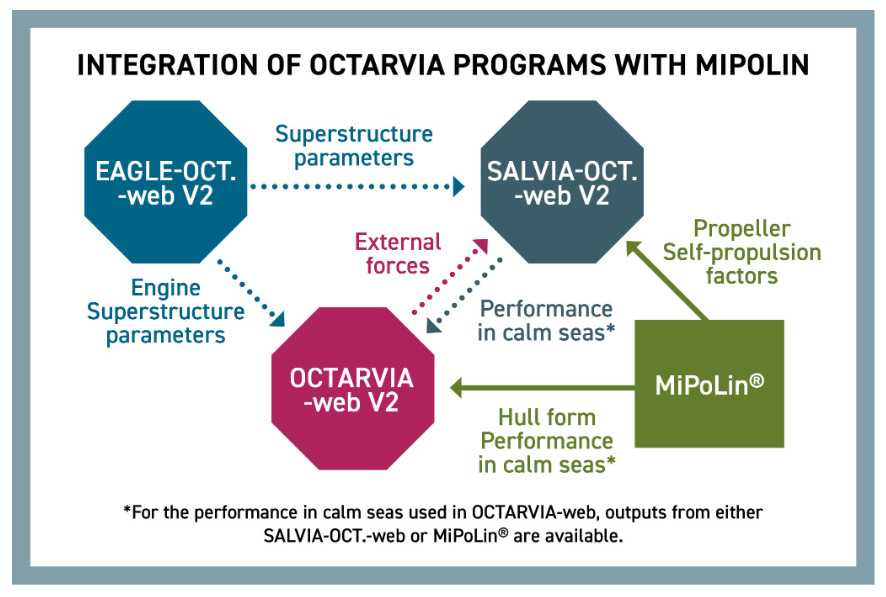
NMRI’s programs — OCTARVIA-web for ship lifecycle fuel efficiency evaluation; SALVIA-OCT.-web for onboard monitoring data analysis; and EAGLE-OCT.-web for analyzing hull performance data — incorporate MiPoLin’s design data estimated from historical data into its own extensive onboard analysis, giving a fuller picture of the likely entire lifecycle performance of the ship in question.
All of these insights make it easier for shipping companies to choose more efficient hull designs up front, improve how ships are operated and, ultimately, reduce GHG emissions from the maritime sector.

Learn more about Mitsubishi Shipbuilding’s MiPoLin
Related tags
SHARE


Madeleine North
Madeleine North has almost 30 years' journalism experience as a writer and editor for leading UK publications.
MHI endeavors to ensure all content published on Spectra is accurate and current at the time of publication; however, data and links are subject to change, and MHI accepts no responsibility for information that has since been updated or amended. For more information please refer to our Terms of use.