


Forging the industrial future: Insights from COP31

What will it really take to scale the next-generation technologies that will move industry to a low-carbon future?
That was a key question asked at the Sustainable Innovation Forum 2026, held at COP31 in Türkiye.
With industry responsible for 30% of global greenhouse gas emissions, governments need the sector’s help to shape policies that will allow faster progress toward COP’s overall objective: advancing the Paris Agreement’s central goal to limit global warming. Even so, delivering widespread progress will also depend on supportive policies, investment and collaboration across sectors.
In Antalya, leaders from across business, government and finance met in the Climate Action Innovation Zone to forge cross-sector partnerships to help make this possible.
The Sustainable Innovation Forum’s role at COP31
The Sustainable Innovation Forum — the Climate Action Innovation Zone’s flagship event — brings business “into the heart of COP,” in the words of the organizers.
It aims to engage corporate leaders and investors and connect them with the decision-makers who shape on-the-ground delivery.
Designed to showcase success, facilitate collaboration and accelerate delivery pathways, key sessions put the spotlight on areas where expertise, technology, investment and operational capacity are needed to accelerate implementation, as well as demonstrating proof of progress and projects underway.

Moving from pilots to projects
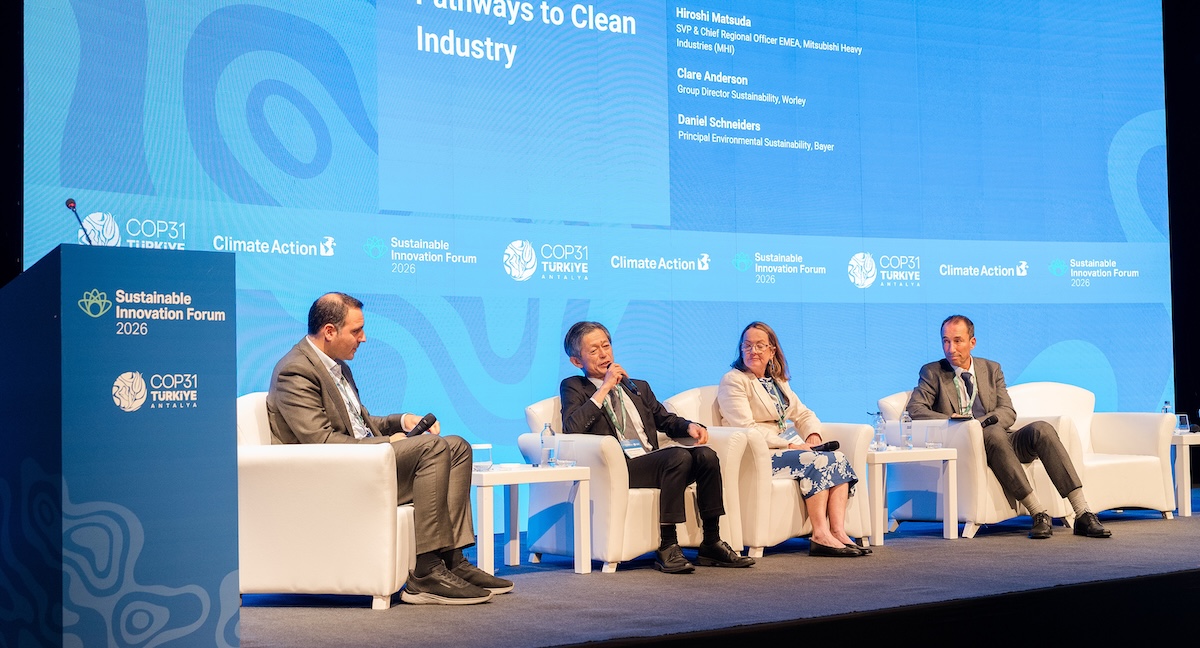
There was tangible evidence of progress presented in a panel session titled ‘Forging the Industrial Future — Clean Materials, Chemicals and Fuels’, which looked at how industry is moving from pilot projects to commercial-scale production across steel, cement, chemicals and low-carbon fuels.
The panelists comprised Hiroshi Matsuda, SVP & Chief Regional Officer for EMEA at Mitsubishi Heavy Industries (MHI); Clare Anderson, Group Director Sustainability at Worley; and Daniel Schneiders, Principal Environmental Sustainability at Bayer. The session was moderated by Noam Boussidan, Head of the First Movers Coalition at the World Economic Forum.
Their wide-ranging discussion covered everything from challenges and successes within these hard-to-abate sectors to how to unlock capital for heavy industry.
Industrial electrification at scale
Panelists discussed how heavy industry decarbonization will require a combination of measures.
MHI’s Matsuda highlighted how electrification and energy-efficient production can cut both emissions and energy demand in hard-to-abate sectors, contributing to climate goals and strengthening resilience.
He pointed to key technologies from MHI Group as success stories in this area. In steelmaking, advanced electric arc furnaces, such as those from Primetals, offer significant emissions reductions compared to traditional methods, as well as using less energy per tonne of steel. Innovations such as induction-based gas heating or endless strip production, which skips the traditional approach of cooling and reheating steel slabs between casting and rolling of flat steel products, are also delivering benefits in terms of emissions reduction, energy efficiency and cost savings.
Large-scale heat pumps are also beginning to make an impact on industry, he said. For example, a paper mill in Finland has recently installed the world’s largest steam-producing heat pump. Made by Turboden, the system uses CO₂-free electricity and waste heat to produce the high-temperature steam vital to paper-manufacturing processes, replacing fossil-fuel systems.
Addressing hard-to-abate emissions
Where electrification is not possible, technologies such as carbon capture and storage (CCS) are also starting to see industrial scale, Matsuda added. In cement, for example, CCS has been described by the International Renewable Energy Agency as “indispensable” to tackle process emissions that cannot be eliminated by other measures.
Delegates learned how MHI CO2 capture technology at a cement works in the UK will capture around 800,000 tonnes of CO₂ per year when it comes online in 2029.
While we will increasingly hear such stories of successful commercial implementation, there is still much to be done in heavy industries — especially with global construction activity predicted to rise by more than 70% by 2050.
In the COP31 Resilient Cities, Buildings and Cooling Pavilion, a panel including Dr. Michalis Agraniotis, Senior Business Development Manager for Decarbonization Business at MHI-EMEA, discussed how carbon capture technologies can help reduce emissions from the construction sector by facilitating permanent storage of captured CO₂ in building materials.
Financing industrial progress
Deploying next-generation industrial assets requires alignment of innovation, infrastructure, demand and capital to allow both proven and emerging technologies to scale profitably and predictably, according to World Economic Forum research.
Panelists discussed how more customers making long-term commitments would create reliable demand for low-carbon processes and materials, and that this must be backed by stable government policies, enabling producers to plan investments.
With research showing continued reliance on fossil fuels leaves 75% of global industry exposed to recurring price shocks, finding the right energy mix is no longer simply about being more sustainable — it is becoming a question of resilience for industrial companies.
Discussions at the Sustainable Innovation Forum showed many are ready to build it.

Learn more about MHI’s work to advance low-carbon energy systems
Related tags
SHARE


David Elliott
David Elliott has two decades’ experience working as a journalist, communications professional and content creator, including for some of the world’s biggest technology brands.
MHI endeavors to ensure all content published on Spectra is accurate and current at the time of publication; however, data and links are subject to change, and MHI accepts no responsibility for information that has since been updated or amended. For more information please refer to our Terms of use.